

How AI can Decommodify and Upskill "Gig Workers"
Millions of adults with soft skills have work, but not a job. AI is controlling their options and cutting pay. Regional bodies enjoy unique leverage to get AI working for breadwinners outside traditional jobs.
Blue-collar work is almost entirely platform intermediated. Thousands of employee scheduling systems and gig work apps determine who works when, for what pay. But each platform is a task-based vertical; Doordash for deliveries, Qwickgo for hospitality bookings, Me@Walmart for shifts at the local Supercenter, Rover for petcare work, and so on.
Selling across multiple platforms is self-defeating[1] . So, workers are stuck in silos. There is no data revealing what types of work, or which platforms, offer the best options.
Lower-skilled breadwinners have decreasing likelihood of a steady job. Some are forced into gig work. Others can't work any other way. All are deployed by tech., as needed, in each silo. Official data barely capture this trend, other reports do. Even pre-Covid, 36% of US adults relied on ad-hoc work.
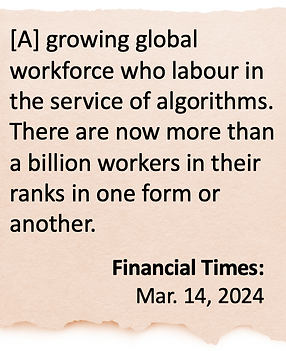
Cuttings on the right reflect how AI is increasingly deployed for "efficiency" and cost cutting around nonstandard work.
------
But a portfolio of blue-collar employment can be enriching. Most people have a multi-faceted range of capabilities and life experiences, each of which they could monetize. The key is horizontal markets for hour-by-hour labor in any region. They can connect each person to all types of work for which they are eligible, hour-by-hour, across multiple sectors.
Each person will be eligible for multiple sectors, choosing their path with real-time, ultra-granular and localized, like-for-like actionable data. AI tools can use that to upskill, trigger support, regularize hours, align supply with demand, plot steppingstones to a goal, foster job creation, and more.
Public agencies in the UK, and now US, have launched pilots showing how their unique leverage can instigate horizontal hour-by-hour labor markets. Our technology development and learning from these initiatives shows the way currently siloed, interchangeable, cheapened, workers can each become a differentiated asset to be unlocked in their local economy; working at times they choose for a mix of organizations, on their own terms, with pathways upward.
Moravec's paradox tells us humanity will remain better at soft-skilled tasks than AI. In reality, soft-skilled work is now nonstandard work. Keeping humans competitive while rewarded for adaptability, reliability and each person's unique capabilities should be an economic and societal priority.
Knowledge workers fear job loss to AI. The middle-skilled will likely find themselves augmented. For the soft-skilled, impact of AI depends on how their time is treated: cost or asset?
[1] If you are unavailable to System A while doing a task sent by System B, A's algorithms will likely downgrade you, curtailing your future work. And vice versa.
[1]
Click on any cutting to open report



Contents of this Briefing

Detailed inputs/outputs/processes behind Section 3 are in a separate Appendices paper.
Downloads
BRIEFING: How AI can Decommodify and Upskill "Gig Workers"
Detailed Appendices for Above Paper