Today's Jobs: The Wider Data
Labor market data can show a person as having a job. But that increasingly reflects just one, unstable, aspect of their income. It's worth probing household earnings from all sources. That reveals traditional employment - with sufficient wages - is declining. The reality of many jobs now is constantly fluctuating hours and pay. So, families must develop diverse sources of top-up income.
About 20% of adults can't take a traditional job because of day-to-day unpredictability in their medical issues, childcare or family caregiving. This briefing focuses on another group of irregular earners: people who tick the box for "in a job" but who, under-the-hood, are likewise scrabbling together ad hoc income.
Top-ups to formal earnings are not new. But today's channels linking lower-paid breadwinners to income are. Since the 2010's algorithms behind digital platforms have increasingly mediated access to hours of work for the low/mid-skilled. Employee scheduling systems do it for those in a formal job. Gig work apps rely on people needing ad hoc work at any time. This splintering of demand for labor has many implications .
What the Data Show
Just counting jobs in any economy ignores swaths of economic activity. To build a picture of household income from wider channels we must go beyond regularly issued labor market statistics to consider one-off polling by official agencies, and independent research, internationally. Datapoints between countries, and research time periods, vary. But a drumbeat of reporting shows how the lower-paid are moving from living off a single job to reliance on diverse streams of earnings.
Findings can be grouped around 5 themes:
-
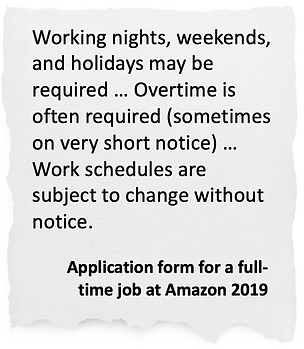
Even formal jobs now pay unpredictably: Getting a job is no guarantee of steady work hours or wages. In 2025, Gallup found 62% of US employees do not have a traditional high quality work schedule. Three years earlier, the Federal Reserve discovered 41% of all workers were subject to unstable hours. The flexibility is almost entirely determined by employers' needs, not what works for an employee.
Evaluating a person's annual income misses the impact of yo-yoing work hours. Drilling into UK payroll data revealed only 26% of the continuously employed had stable pay in 2025. Analysis of banking transactions shows fluctuations in pay within a single job causes 86% of Americans' income volatility. In the US, one writer learned rotas can swing from 4 hours one week to 39 the next. Attempts to calm this volatility with Fair Work Week acts have slight impact given the scale of destabilizing scheduling.
-
Holding multiple jobs is increasing: As primary employment fragments, lower-income workers are taking more than one formal job. Canadian government statisticians established multiple job holding more than doubled between the mid 1970's and the mid 2020's, some estimates now put it at one-in-three full-time workers. A 2024 survey found 1-in-3 US adults juggled more than one job. In 2023 UK investigators surfaced workers with over four jobs each for a different employer, in varying locations.
-
Platform work is supplementing other income sources: Some people drive Uber as a full-time job. But Pew Research in 2021 recorded most earners on gig work apps either did less than 10 hours a week, or only did the work on a minority of weeks. Just 8% did more than 30 hours a week. For 52% of respondents, gig work was to cover uncertain income from elsewhere. It all points to job-holders seeking top-up work.
-
Undeclared work is bigger than platform work: Informal housecleaning, babysitting, petcare, shopping, selling goods or providing senior care nets US households more income than working through apps like Uber, TaskRabbit or AnyShift. The Federal Reserve SHED survey found 28% of adults earned from informal or occasional activities in the prior month in 2016. In 2013, polling by the Boston Fed. established 44% of respondents had done some informal paid work in the previous two years. Europe's Labour Authority measured 11% of total labour input that was undeclared in 2023.
Finding these informal blocks of work hours involves either word of mouth contacts or advertising, typically on sites like Facebook. Few gain a full-time income from shadow work. Inadequate formal work is a key driver. Federal Reserve researchers found 43% of full-time employees topped up with off-the-books work. UK tax authorities say 10% of Brits earned illegally in 2022, double the number in 2016; 65% of them were moonlighting, earning alongside formal declared activity.
Estimates of shadow work can undercount. People tend to be shy about discussing their illegal activity with researchers. European Union polling in 2019 had 3.5% of adults admitting to informal work. Academics probed for inconsistencies in the data and arrived at 17% of adults as the more likely figure.
-
Supplementary work is driven by need: Erratic pay is most common at either end of the income spectrum. The affluent may choose it. For the most poorly paid, unstable income is largely unavoidable. JPMorgan Chase analysis of bank transactions showed 74% of Americans in the lowest income quintile experienced a month-to-month change in total income over 30%, compared with 55% in all bands.
Pew discovered 70% of platform gig workers regard app earnings as vital to meeting basic household needs. Canadian government statisticians found 35% of multiple-job holders cited essential needs as their motivation. America's Urban Institute revealed 45% of the lowest paid rely on nonstandard work, versus 26% of all adults.
Even within the lowest paid, there are inequalities. Black workers are more prone to volatile work schedules (RSFJSS). In Britain, the young are over-represented in shadow economy activity (HMRC). Women may find themselves having to do the least popular assignments.
Why This Matters
Just asking "How do we get more people into jobs" misses today's nuanced reality for lower-income households. Acknowledging that a job can turn into just one income source explains inconsistencies in official datasets, and opens new possibilities for boosting earnings, opportunity and resilience.
Expecting solid data to conclusively prove the extent of diverse household income streams is unrealistic. Low income individuals seeking top-up earnings are so often forced into off-the-books work. Even visible parts of this activity are high-churn and typically involve only small amounts of money, barely registering on wider surveys. Percentages above will overlap; someone can have a job that fails to deliver enough hours, so they do some platform gig work, find a second job AND clean a neighbor's house weekly for cash. That would put them in several of the datasets listed.
But a trend away from a stable job meeting full income needs, towards patched-together income, is exposed in an array of research. Many workers involved are desperate. Even in 2015, 92% of Americans regarded income predictability as more important than economic mobility. Now, polling reveals, many adults who - rightly or wrongly - fear job loss to AI, or other economic vulnerabilities, consider secondary income as a safety net they will need at some point. This is particularly true for the young.
Political Responses
Aside from ongoing attempts to mitigate the unfairness of scheduling, governments have approached diversifying of household income streams along a spectrum. Countries that were least prepared demonstrate the diversity of thinking.
Some jurisdictions entered the digital platform era with established structures already open to portfolio earnings. Germany's officially sanctioned, centrally registered, "mini jobs" have long encouraged supplementary employment below an income cap, currently 603 Euros ($690) a month. Japan started a shift to non-regular employment in the 1980's, prioritizing employment for women and allowing companies more flexibility. Denmark is noted for both high labor market attachment and income security but combines it with 20+ average weekly hours for working people outside traditional employment. Their government promotes reductions in work hours.
Other nations have tried 5 broad responses:
-
Bring back jobs: Spain more than halved temporary employment with 2021 labour reforms that restricted temp contracts and pushed rolling employment agreements. Britain's Labour government used a 2025 Employment Rights Act to enforce foreseeable hours and restore structured jobs.
-
Stamp out informality: Off-the-books household earnings are attacked by tax authorities around the world. Projects like India's controversial Aadhaar identity database aim to curb shadow activity.
-
Support nonstandard earners: In the US, moves to provide employee benefits that span diverse sources of income have come from Democrats (in 2022) and Republicans (2025) in the Senate. Britain's Universal Credit core public assistance program incentivizes income from multiple sources.
-
Verify multiple earnings: Mandatory work requirements in the US force assistance claimants to prove they are doing 80 hours of "work related activity" each month. A lucky subset will get that from a regular part-time job. Most will be diversified.
-
Encourage multi-source employment: The UK's Conservative Party explicitly encouraged multiple jobs for the lower paid by banning, in 2022, exclusivity clauses for low paid employees that stopped them also working for competitors. The minister in charge said workers "must have freedom to top up pay".
Again, fuzzy data make it hard to evaluate measures like this. Spain might seem to have fostered traditional employment. But their informal economy remains, at 17%, significantly higher than neighbors and peers, so other factors are in play. Britain's clampdown on one-sided employee scheduling could boost apps such as Temper and Indeed Flex that supply day-to-day labor. Replacing regulated employees with on-demand "freelancers" allows US corporates to retain flexibility and keep costs down.
Implications of Multiple Incomes
If we recognize many breadwinners require - or fear they will soon be seeking - top-up income, adapted policy, support and welfare become a priority. Underlying all of them is need for neutral, inclusive, fully featured, market infrastructure.
Someone earning from a single job will interface with the labor market maybe every few years when they want a better position. Breadwinners reliant on multiple sources can engage with the market several times a day in search of a next block of work hours or other earning opportunities. Their channels to demand are vital.
The quality of markets available determines issues like:
-
Extent of exposure: Any work-seeker wants to be available for as many opportunities as possible. Siloing of gig work apps and shadow demand severely reduces the visible options.
-
Easing complexity: Juggling overlapping work periods, waiting for assignments, insufficient notice and other frictions consume huge amounts of time for people juggling multiple income streams while lacking skills for at-home freelancing.
-
Welfare and protections: So much infrastructure supporting working families is built around 20th century assumptions about a single-job providing sufficient income. Prorating everything to hour-by-hour earnings from diverse sources requires operational restructuring.
-
Skilling: Instead of solely focusing on traditional credentials, low-cost interventions should be able to impact quickly as they improve alignment. As example, group-training of local retail workers in food handling creates a pool of top-up staff for the hospitality sector, and wider options for the certified workers.
-
Opportunity data: Anyone working hour-by-hour should be able to see patterns of supply, demand and pay across their travel-to-work area for each of their capabilities, and any they may be only a training course away from acquiring. New economic metrics and indices could track outcomes for multi-source earners as official data do for the main labor market.
There are thousands of apps and services that each offer a sliver of the available work or support needed by households developing portfolios of income. A Work First approach prioritizes getting each person the hours they need, on their terms, for the best pay. Benefits, protections, skilling, assistance, supportive interventions and progression can then be integrated into the market connecting each person to earnings.
Getting someone the best-fit work from as many competing employers as they need should be a starting point for support. That brings market forces, not just regulation, to bear on companies currently wielding the power of monopsony systems.
But there is a chicken-and-egg to addressing diversifying income. Decision makers understandably want concrete data to show it is happening before they act to initiate better markets for multi-source earners. But the missing data can only be surfaced once a region has deep hour-by-hour labor markets with open data.
<- Home
MM4A (Modern Markets for All) Nonprofit - Released under a Creative Commons CC BY licence 260921
Click on any cutting below to open report