Initiatives to Protect Nonstandard Workers
Since the 2010's blue collar work has become increasingly platform mediated. Systemic undermining of workers by thousands of employee scheduling systems and gig work apps has prompted regulatory and other attempts to mitigate the harm. This page categorizes those efforts with examples. It explores why these initiatives have not succeeded as hoped.
BACKGROUND: Rise of Labor Platforms
----
Gig work apps (Doordash, Rover, TaskRabbit, Uber) make headlines. But employee scheduling firms that run monopsony labor markets for their corporate customers (Kronos UKG, Workday, Infor, ATOSS, Dayforce, ZIP) are probably more impactful. All these platforms are shaped around their operator's priorities; minimizing labor costs, and keeping workers responsiveness, are typical aims.
In the 1990's Kronos Inc., a manufacturer of workplace timeclocks began developing scheduling software. Their dominance of the sector was enshrined when Workforce Central 8 (released 2015) became a category bestseller. WC8 has been marketed to finance directors with slogans like "Manage your workforce without limits".
Scheduling software is a growing and profitable sector. It is hard to know how any organization's system is configured, but a supermarket manager's rule to "keep staffing costs at my specified percentage of turnover through the checkouts each hour" is a plausible example. AI can supercharge the one-sided efficiencies of these powerful technologies.
As breadwinners increasingly transitioned from sufficient wages from a single job to income from multiple sources, widespread need for extra hours elsewhere created a supply of workers for gig apps. Record-breaking valuations for Uber, launched in 2011, created the playbook for countless apps aiming to be "The Uber of...." lawncare, cleaning, driving, warehouse work, or some other commodifiable task.
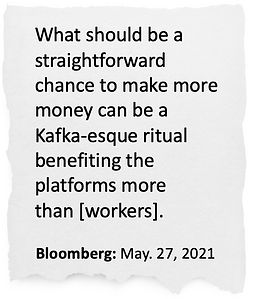
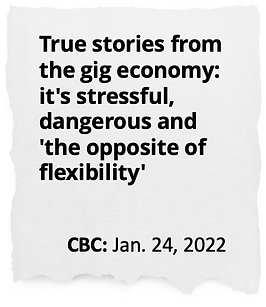
The fragmenting of employment has many impacts including anxiety driven by algorithmic unfairness, poor health, financial precariousness and political radicalization. By 2015, the OECD reported unstable work was a primary driver of inequality in industrialized nations. Policy changes permitted precariousness; platforms drove it to new depths.
EXAMPLES: Specific Efforts to Mitigate Platform Workers' Problems
This list can never be exhaustive, projects and apps come and go. Others pivot to new models. We group initiatives into 20 types of solution within 5 categories.
i) Organizing

ii) Policy/legislation

iii) Litigation

iv) Alternative models

v) Additional apps

CONTEXT: Challenges of Mitigation
Aside from illegal off-the-books work, people needing personalized hour-by-hour employment have little choice other than today's platforms. With no publicly provided infrastructure for hour-by-hour labor, startup companies have been able to shape this growing part of any economy.
Governments worldwide provide labor market infrastructure; Job centers are an alternative to for-profit staffing agencies, all-sectors job-match platforms such as those commissioned by each US state compete with commercial job boards. (Other countries do the same nationally, for example Canada, Australia and Britain.) Agencies have not done the same for the exploding world of nonstandard work. That has left the technologies, business models and culture of platform companies creating 5 barriers across attempts to mitigate the social and economic damage:
-
Complexity: Technology running labor platforms can be impenetrably sophisticated. Data is secreted. It is a battle for campaigners to prove wrongdoing, unfair intent or market manipulation. And the sector itself is ever-evolving. Apps come and go in dizzying succession. As one example, Uber extended in 2018 into a general labor market, launched in Chicago and Miami, then abandoned it in 2020. Events can move faster than regulators.
-
Business models: Cheapened, commoditized, controllable labor is core for companies that can have hemorrhaged investor cash subsidizing their way to market dominance. This is illustrated by gig companies' response when California’s AB5 bill forced them to give workers employee rights in 2020. They threatened closure, then invested $205m to overturn the legislation. Success gained them new customers and an increase in valuations of $13bn. That 6,241% return on blocking workers' rights is the grim financial logic campaigns against platforms face.
-
Fungibility and churn: Gig app operators have no incentive to favor on-going connections between workers and clients (some have fined off-platform relationships, like offering a gig worker a job). This creates high churn among workers who remain commodified for clients unable to request a favored individual. Coupled with lack of progression, this keeps workers interchangeable, diminishing their power. Your current workforce organizes a strike? Just recruit more, the overheads of registration are borne almost entirely by the work-seekers.
-
Circumvention: The factors above underpin scenarios where a seeming political victory for workers can be quietly neutralized by platforms. Feed a minimum wage rise into a scheduling platform told to hold labor costs at a fixed percentage of revenue and it can shave hours very precisely. It is claimed Whole Foods did this. Legislation like Ontario's ban on arbitrary deplatforming could lead to workers who assert their rights remaining on the platform, but not getting assigned any work. UK mandates around "guaranteed hours offers" will likely lead to automated churning of assignments to avert protections. And so on.
-
Framing: By vacating the space for labor market infrastructure outside of traditional jobs, public agencies have allowed platform companies to peddle a false dichotomy. They repeatedly claim "People who need personalized work hours have to choose flexibility over employment rights". It's not true. But lobbying bodies, company CEO's and advertising pushes this message, allowing the companies to position themselves as champions of people who need nonstandard work. Regulators and campaigners can then be framed as out-of-touch dangers to those hard-pressed breadwinners.
LEARNING: Limits of Mitigation
Curbing abuse of workers should not be confused with unlocking the potential of labor platforms to empower individuals needing nonjob work. Even if every corporate employer and gig company abandoned their business model and restructured around workers' needs, breadwinners would remain stuck in narrow silos of activity. Unlocking the potential requires horizontal (all work types made seamless) hour-by-hour labor platforms.
This siloing by types of work is not an issue for high skilled professionals. An architect will maximize her income by designing buildings. None of her other abilities in life will generate as much income. She just needs a market that connects her with people who commission buildings.
But soft-skilled workers typically have multiple experiences (maybe childcare, petcare, ability to cook, a driving license, competence with computers, perhaps a second language). They benefit in a horizontal labor market (all types of work seamless across one platform with like-for-like data enabling comparison of demand, supply and hourly pay across sectors). In this world, a person can earn from their life experiences and aspirations as they wish, with maximum marketplace power.
A horizontal market can be structured around "Work First". Its primary objective is getting each person whatever periods of employment they need now. Functionality that pays benefits, ensures compliance, builds stability, generates data and creates progression pathways can all then be integrated. It's an alternative to navigating many standalone apps and services.
Only public agencies with their leverage over regional flexible labor spend and supportive facilities have the heft to launch horizontal markets. Companies have no incentive to do so.
So, campaigners, entrepreneurs, political candidates, social reformers and others continue battling to compel a shifting sand of thousands of vertical labor markets to treat workers with a minimal level of respect. Many of these efforts deserve kudos, some have lastingly curbed exploitation. But the odds are stacked in favor of deep-pocketed, aggressive, platforms.
MM4A (Modern Markets for All) Nonprofit - Released under a Creative Commons CC BY licence 260818
Click on any cutting below to open report